






Max Trescott (my CFI) and I picked up my T206H the week of May 31. We flew to Independence Kansas to get it. Below is a write up he did in his monthly newsletter regarding our trip. The complete issue can be found here: http://www.pilotsafetynews.com/PSN0507.htm
Cessna Factory Visit
Disneyland for Adults?
Usually I spotlight something related to flying safety. But,
please indulge me this month while I share a little about the couple of
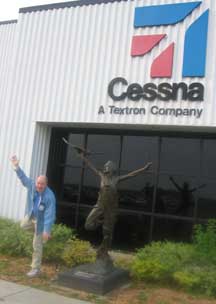 days I
spent at the Cessna factory a month ago. As you can guess from the subtitle
above (or the picture of me imitating the statue), we had a great time. And I
highly recommend that you go out, buy a new airplane and pick it up yourself at
the factory. If you need a CFI to come along, give me a call!
days I
spent at the Cessna factory a month ago. As you can guess from the subtitle
above (or the picture of me imitating the statue), we had a great time. And I
highly recommend that you go out, buy a new airplane and pick it up yourself at
the factory. If you need a CFI to come along, give me a call!
Thanks to Dan for buying a new T206. He's a new pilot and, because of time in type insurance requirements, needed a CFI along on the trip. Naturally, I was flattered that he hired me to come along on the trip.
It's probably no surprise to most readers that the cockpit of new aircraft have undergone a radical change in the last year. Manufacturers are shipping virtually every new airplane with glass cockpits. People just aren't buying the old "steam gauge" versions anymore, even though they are still available as options. About 90% of all new airplanes shipped now go out with glass cockpits.
As I've said before, I believe the new cockpits are going to have a large impact upon reducing accident rates. However, there is a learning curve associated with them, which is why new Cessna owners get a three-day "G1000 transition training" course at the factory or from authorized instructors in the field. Doing it at the factory has the benefit of allowing you to tour the production line and ask the experts any question you have about your new plane.
Welcome to the Factory, May I
Search You Please?
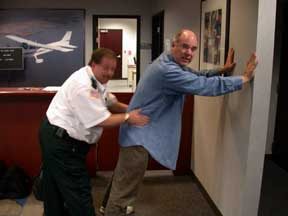 The
first thing that happens when you arrive is that they search you. JUST KIDDING!
Everyone we met was incredibly friendly and helpful. I don't recall having ever
visited a facility that was so customer service oriented. How far will they go
to satisfy a customer? When I asked the guard at the front desk to help us
fake a picture of me being searched, he laughed and obliged. So even the guards
know which side their bread is buttered on. Anyone who wants to make their
company more customer service oriented could learn something from Cessna. We
enjoyed every minute of our time there, and it was the Cessna employees who made
it so enjoyable. To be fair, I'm sure the other aircraft companies are also
excellent.
The
first thing that happens when you arrive is that they search you. JUST KIDDING!
Everyone we met was incredibly friendly and helpful. I don't recall having ever
visited a facility that was so customer service oriented. How far will they go
to satisfy a customer? When I asked the guard at the front desk to help us
fake a picture of me being searched, he laughed and obliged. So even the guards
know which side their bread is buttered on. Anyone who wants to make their
company more customer service oriented could learn something from Cessna. We
enjoyed every minute of our time there, and it was the Cessna employees who made
it so enjoyable. To be fair, I'm sure the other aircraft companies are also
excellent.
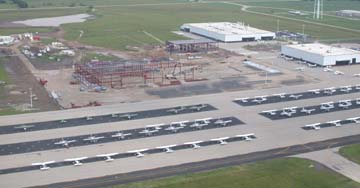
The 172/182/206 factory is in Independence, KS, not in Wichita (as many people think) where Cessna builds the Caravan and jets. To get there, you fly into Tulsa, OK and drive about an hour and a half to Independence. There are a lot of fields and oil wells along the way. The biggest hill we saw enroute was a buckle in the pavement. It turns out that May is also the month in which they receive the most tornadoes--but fortunately they set a new record by having none in May this year.
Business at Cessna is obviously good, as there is a lot of construction going on. Currently, the aircraft prep and paint occur in the same building. In the future, separate buildings will eliminate dust particles from the prep area finding there way into the paint shop. There's also a new customer delivery center being constructed. Starting in late-2006, Independence will also start shipping the new Mustang mini-jet and they need larger and fancier facilities to accommodate the jet business.
Ground School
We started with 3 hours of ground school. There are two classrooms set up with a
high tech projection screen and terminals for everyone in the class. Most of the
time, the terminals show copies of the PowerPoint slides being projected on the
screen. Periodically, however, the terminals are switched so that they run
copies of the Garmin G1000 software simulator. Everyone in the classroom then
runs though the exercises on their own simulator. This includes simple things,
like entering COMM frequencies, to more difficult tasks like re-programming a
flight plan to accommodate changes in destination or instrument approach
procedure.
 Lunch was in
the factory cafeteria. The food is fine, but the highlight was rummaging
through the company store located in the cafeteria. We came back with Cessna
shirts and hats and posters and more smiles.
Lunch was in
the factory cafeteria. The food is fine, but the highlight was rummaging
through the company store located in the cafeteria. We came back with Cessna
shirts and hats and posters and more smiles.
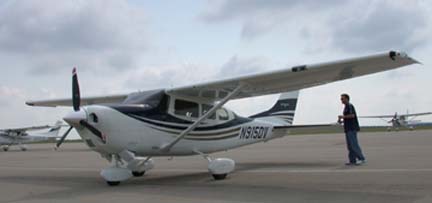
In the afternoon, we got to see Dan's new T206 and fly the acceptance flight. You can see him checking out his new plane in the photo to the left. He didn't stop smiling for days.
We spent a lot of time looking it over externally and then flew with a delivery pilot who ran through all of the systems to assure that everything worked. There were virtually no squawks and they were so trivial that I've already forgotten what they were. The plane is beautiful. The engine purrs. The interior is leather. The cockpit is all glass. This is not your father's Oldsmobile! That night we celebrated by joining other customers and factory personnel for dinner in town.
Day Two--Boy are they customer
service oriented!
 Day
two started with another 3 hours of ground school. Dan commented that he had
never seen a PowerPoint presentation with as many slides in it. It was hundreds
of slides, but our instructor went through it quickly. Somewhere along the
line, we realized that they had planned for us to be there for three full days
of training, whereas our plan called for only two days.
Day
two started with another 3 hours of ground school. Dan commented that he had
never seen a PowerPoint presentation with as many slides in it. It was hundreds
of slides, but our instructor went through it quickly. Somewhere along the
line, we realized that they had planned for us to be there for three full days
of training, whereas our plan called for only two days.
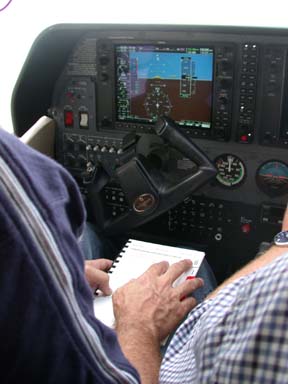
In another example of customer responsiveness, they asked Dean, our instructor/pilot, to fly late with us and pack two days into one. Soooo, we each had about 3.5 hours of flight training that day in the T206. Some of the approaches were into Tulsa and we commandeered the courtesy car at an FBO, packed six people into it (since we met up with another customer flight) and drove to a local restaurant for dinner.
Most of my 3.5 hours of training was after dinner at night and we got back into the Independence airport about 11:30PM that night. Surprisingly, the customer delivery center was still in full swing. Did I mention that business must be good? Later we found out that Dean lives in Tulsa and still had a 90 minute drive home that night. Did I mention that the Cessna employees are incredibly accommodating? Everything about the visit impressed us, particularly the employees and their attentiveness.
Homeward bound
The next morning we were at the factory at 7AM, since it was the only
time in which they could squeeze in our factory tour. Steve, the training
manager took us around which was fun since he is a former factory floor
supervisor and knew everyone. Whereas they originally had two assembly lines,
they have now consolidated into one so that there's room to install the Mustang
jet assembly line. Planes start at one end of the building as a collection of
parts and roll out the other end fully assembled, though not painted.
 Preparation
and painting occur in another building. Formerly tape was used for some of the
decals, but now almost all of the design is painted onto the plane. It adds a
few hours to the process, but the exterior now lasts longer. The best part of
the tour was looking into the paint shop to the see only Mustang jet in
existence, which had just receive a coat of paint over night. I was struck by
how much larger it looked than I had imagined. Although it has only six seats,
it stands considerable taller and longer than it's little six seat buddy the
T206. Flies a little faster too I hear.
Preparation
and painting occur in another building. Formerly tape was used for some of the
decals, but now almost all of the design is painted onto the plane. It adds a
few hours to the process, but the exterior now lasts longer. The best part of
the tour was looking into the paint shop to the see only Mustang jet in
existence, which had just receive a coat of paint over night. I was struck by
how much larger it looked than I had imagined. Although it has only six seats,
it stands considerable taller and longer than it's little six seat buddy the
T206. Flies a little faster too I hear.
We were wheels up at 8:30AM and flew for the first two hours at about 2000 AGL to stay below a layer of clouds. First stop: Liberal, KS. We refueled and re-examined the radar picture, which showed a band of showers still to the south and west of us. We had thought we would have the Garmin data link in the plane, which would have downloaded real-time weather graphics from XM satellite, but unfortunately that won't ship for another month or two. That will really revolutionize flying. Imagine flying along pulling up not just metars, TAFs and Winds Aloft, but being able to see graphical depictions of Airmets, freezing levels, satellite and radar imagery and GET THIS--Temporary Flight Restrictions! It's a new world, and I like it.
From Liberal, we flew north, avoiding lightning strikes displayed on the Stormscope, and visually avoiding the darker areas of rain and clouds. Heading south and west as we approached Trinidad, CO we were able to gradually climb as the clouds rose and eventually disappeared. Next stop: Las Vegas, New Mexico, which is apparently a popular gas stop on the East/West route as a Cessna dealer we met at the factory had mentioned it.
Winds at Las Vegas were approximately 30 knots, which the ground personnel told us is fairly typical there. The New Mexico State Aeronautical map gave us a laugh as it has a symbol for "Alien Crash Site" at Roswell, NM. A picture on the wall commemorated the landing of Lindbergh at Las Vegas some 75 years ago. I think things have been a little quiet there since then.
G1000
Fuel Range Ring to the Rescue
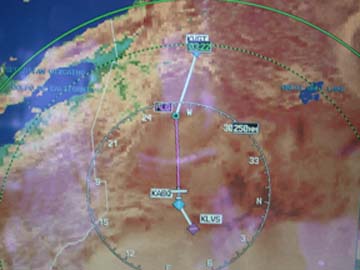 From
there we launched for the other Las Vegas, with a route over Albuquerque and
Flagstaff. Over Albuquerque, we experimented with the trip planning function
and the fuel range ring and realized that our destination was about half way
between the "range to reserve" ring and the "range to fuel exhaustion" ring.
Since we'd set the reserve for 1 hour, that suggested we'd have about a half
hour of fuel upon landing, which neither of us found particularly comforting in
an aircraft in which we hadn't had prior experience with the fuel gauges. On the
other hand, we wanted to avoid an extra fuel stop if possible.
From
there we launched for the other Las Vegas, with a route over Albuquerque and
Flagstaff. Over Albuquerque, we experimented with the trip planning function
and the fuel range ring and realized that our destination was about half way
between the "range to reserve" ring and the "range to fuel exhaustion" ring.
Since we'd set the reserve for 1 hour, that suggested we'd have about a half
hour of fuel upon landing, which neither of us found particularly comforting in
an aircraft in which we hadn't had prior experience with the fuel gauges. On the
other hand, we wanted to avoid an extra fuel stop if possible.
Fuel Range Ring to the rescue! Ironically, when I first saw this feature several months earlier, I dismissed it as being unnecessary glitz. Well I was wrong. It's an excellent planning tool for longer cross country flights that provides instant, graphical feedback. We starting adjusting the power and mixture controls and almost immediately found a combination that would give us at least an hour of reserve fuel upon landing and only knocked a couple of knots off of our airspeed. The photo, which I shot of the display after the adjustmets, shows our destination next to the inner range ring, indicating we'd land with an hour of fuel. It worked great. We landed with almost 20 gallons of fuel and also verified that the fuel gauges are highly accurate.
We stayed overnight in Las Vegas, NV and our 3 hour flight home the next morning was uneventful. Overall, the flight took about 13 hours. While we average about 150 knots, we had 40 knot headwinds most of the first day. During the flight, we explored virtually every feature of the G1000. For example, on the last leg we used the VNAV or vertical navigation function, to show us graphically on the map when to start are 400 fpm descent so we'd arrive at RHV at traffic pattern altitude.
In summary, if you're considering buying a new airplane, pick it up at the factory if you can. You'll learn a lot from the factory people and get a lot of experience in the airplane on the way home. If you lack experience in the new plane, bring along a CFI to make you're trip safer and even more fun. But, be prepared to have a non-stop grin on your face for at least a week!
